
India and Russia are poised to sign multiple agreements to bolster cooperation in various sectors, including trade and healthcare, during Russian President Vladimir Putin's visit to New Delhi. Discussions will also address the Ukraine conflict and efforts to increase Indian exports to Russia.

Wholesale price inflation (WPI) came in at (-) 0.32 per cent in November, driven by an uptick in prices of food articles like pulses and vegetables on a month-on-month basis, government data showed on Monday.
'The US is strongly placed to expand its crude supplies to India.'

Growth of eight key infrastructure sectors remained flat in October as expansion in output of petroleum refinery products, fertiliser and steel was offset by a contraction in coal and electricity production, according to official data released on Thursday.
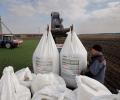
For the first time, the government is likely to dip into the Oil Industry Development Fund (OIDF) to finance part of its fertiliser subsidy programme for 2025-26, according to official sources. The finance ministry has accounted for Rs 23,000 crore in the FY26 Budget as net additional resources to be drawn from dedicated reserve funds, including the OIDF, the Agriculture Infrastructure and Development Fund, and the Universal Service Obligation Fund.
The petroleum ministry has recommended a hike in the foreign direct investment cap in government-owned refineries to 49 per cent from the current 26 per cent.

On the table are additional batches of S-400 surface-to-air missile systems from Russia, which India used with immense success during Operation Sindoor. India could buy at least two squadrons of Su-57 fighter jets plus joint production of S-500 air defence systems.

Russian President Vladimir Putin will make a two-day visit to India from December 4 to hold annual summit talks with Prime Minister Narendra Modi that is expected to produce a plethora of significant outcomes, including in the defence sphere, to further solidify the bilateral strategic ties.
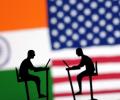
The first phase of the proposed India-US bilateral trade agreement (BTA) is 'nearing closure' and would address the hefty 50 per cent tariffs imposed by the Trump administration on Indian goods, in addition to resolving America's market access issues, a government official said on Monday.
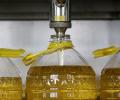
The government on Friday hiked customs duty on crude and refined sunflower oil to 20 per cent and 32.5 per cent, respectively. According to a finance ministry notification, the basic customs duty on crude palm, soybean and sunflower seed oil has been increased from nil to 20 per cent.

India has rejected White House Trade advisor Peter Navarro's comments on New Delhi for its procurement of Russian crude oil, calling them 'inaccurate and misleading'. The relations between New Delhi and Washington are on a downturn after President Donald Trump doubled tariffs on Indian goods.

The family of a man suspected of involvement in the Delhi blast near Red Fort metro station has expressed disbelief, stating that he was an introvert focused on his studies and work.

'A deal will only be possible if India stops buying Russian oil -- but even then, New Delhi must not compromise its core red lines.'

A massive drone strike on the world's largest crude-processing facility operated by Saudi Arabia's Aramco has driven oil prices to their highest level in nearly four months. The attack has knocked out over half of Saudi Arabia's production as it cut 5.7 million barrels per day or over 5 per cent of the world's supply.
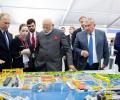
India is preoccupied with analysing the US sanctions, which may cut off India's access to discounted Russian crude and force it to buy at market prices.

'What we are willing to do is definitely going to depend on what the Indian government wants to do.'

The commerce ministry on Tuesday said the discussions with visiting US Chief Negotiator Brendan Lynch on the proposed bilateral trade agreement were positive and forward looking.

Wholesale price inflation (WPI) fell to (-) 1 .21 per cent in October, driven by a decline in prices of food articles like pulses and vegetables, as well as lower fuel and manufactured items' prices, government data showed on Friday.
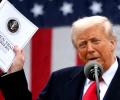
India does not do trade agreements in a hurry or with a "gun to our head", Commerce and Industry Minister Piyush Goyal said on Friday. He said India is actively negotiating trade pacts with countries and regions, including the European Union (EU) and the US.
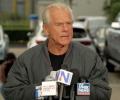
Calling the community note on X "crap", Navarro alleged that Elon Musk is allowing "propaganda" and reiterated his accusations of India purchasing Russian oil only to make profits.
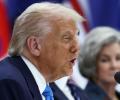
United States President Donald Trump on Wednesday said that the US is 'doing a trade deal with India' as the two sides continue to hold talks on the proposed trade pact.

'There are times when India should stand up without hesitation and voice its indignation over the US' pressure tactic. This is one such moment,' asserts Ambassador M K Bhadrakumar.
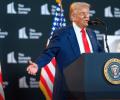
The comments come ahead of Trump's high-profile meeting with Russian President Vladimir Putin, scheduled for Friday in Anchorage, Alaska.

'Don't look at Russia only as a place to earn quickly and then leave.' 'Try to build experience in serious companies, skills and certifications that will serve you anywhere in the world.'

The Russians have termed Putin's visit to India, his first to this country since the outbreak of the Russia-Ukraine war, as 'Druzhba Dosti', which means 'friendship' in Russian and Hindi respectively.
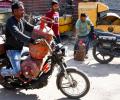
Cooking gas or Liquified Petroleum Gas (LPG) price has been raised by Rs 50 per cylinder by distribution companies, Union Oil Minister Hardeep Singh Puri said on Monday.

Among Sensex firms, State Bank of India, Bharat Electronics, Kotak Mahindra Bank, Maruti, Trent and UltraTech Cement were the major gainers. However, Bajaj Finserv, Titan, ITC and Tata Steel were among the laggards.
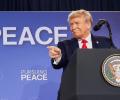
Notably, US President Donald Trump and his administration have continuously targeted India over its purchase of Russian crude oil. India, on the other hand, has always maintained that India's purchases are based on its domestic needs and economic security.

The cost of any flight from Delhi and Mumbai could rise by up to Rs 3,000 soon unless the airport regulator is able to reverse a court order.
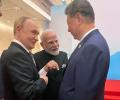
The relations between New Delhi and Washington are on a downturn after Trump doubled tariffs on Indian goods to a whopping 50 per cent, including a 25 per cent additional duties for India's purchase of Russian crude oil.

India's leading agriculture commodity exchange, the National Commodity & Derivatives Exchange (NCDEX), has decided to acquire around a 20 per cent stake in a new commodities and financial derivatives exchange being set up in Sri Lanka, subject to regulatory and governmental approvals. The move aims to deepen NCDEX's footprint in the financial ecosystem of its neighbouring country.

'Both initiatives are welcome moves and we would commit ourselves with focused attention aligned with the national priorities, and pursue our exploration initiatives.'

Once a quiet riverside ritual, Dev Deepawali has evolved into UP's largest soft-power spectacle -- merging faith, art, enterprise into a global cultural brand that reflects state's growing confidence.
There were apprehensions that additional secondary tariffs would have hit India in case the US decided to enforce them.

With the India-US trade talks moving in the right direction, Commerce and Industry Minister Piyush Goyal is expected to visit Washington soon, sources said.
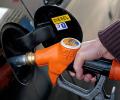
Growth in demand for diesel, India's most consumed petroleum product, fell to its lowest since the pandemic in the financial year ended March 31 as the economy expands at a slower pace and consumption shifts to cleaner fuels. Diesel consumption rose 2 per cent to 91.4 million tonnes in 2024-25 (April 2024 to March 2025) fiscal, according to provisional data released by the Petroleum Planning and Analysis Cell (PPAC) of the Oil Ministry.
The Indian team has returned from the US after holding trade talks with their American counterparts in New York, an official said on Thursday. Commerce and Industry Minister Piyush Goyal, who led the team, will be back on Friday.

'Modi's a great leader... But I don't understand why he's getting into bed with Putin and Xi Jinping...'

Russian President Vladimir Putin announced his upcoming visit to India in December and expressed his intention to address the trade imbalance between the two countries, particularly concerning India's crude oil imports from Russia. He also lauded India's independent stance on international issues and highlighted the strong relationship between the two nations.

...on par with oil, power, and defence, and to restrict its storage under foreign control.
